
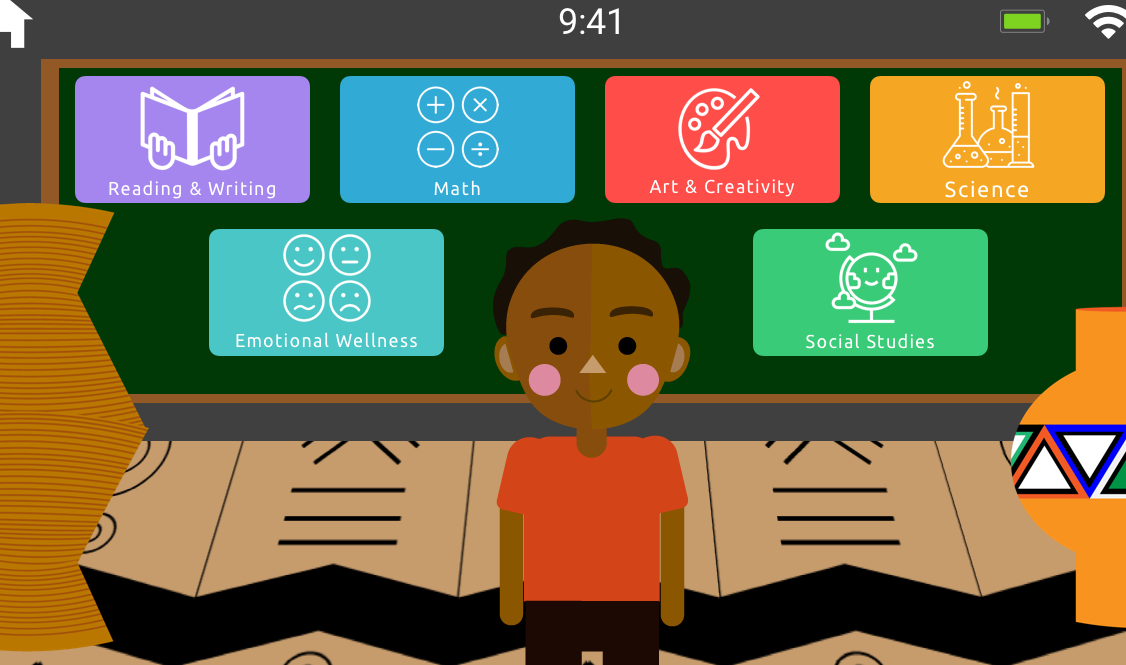
@kumbaya we designed “zeroXess” as a solar-Powered, Communications and IoT Hub, (Incl. OTT, Content and Data solutions) to help and equip each household of marginalized populations with the knowledge and skills required to reduce poverty and drive sustainable development. Electrification powers connectivity. Connectivity powers knowledge. Knowledge powers social and economic progress.
The World Development Report 2018 revealed many countries were experiencing a “learning crisis”: Children are attending school but not necessarily learning. For example, in Ghana and Malawi, 80 percent of students at the end of grade two, or around 8 years old, were unable to read a word such as “the” or “cat,” while in Nicaragua, only 50 percent of a grade five class, ages 10-11, could solve the sum 5+6. According to the report, poor service delivery, unhealthy politics, and unaligned policies around education for all were to blame.
Experts believe Sustainable Development Goal 4 — which calls for all children to complete free, quality primary and secondary education by 2030 — is far off track.
The learning rates will stagnate in middle-income countries and drop by almost a third in Francophone African countries meaning that, globally, 20% of young people aged 14-24 and 30% of adults will be unable to read by 2030.
UNESCO showed that, despite progress in closing the gender gap in education in recent years, a third of countries still do not have gender parity in primary school and half do not have equality in secondary education.
UNESCO pointed to a lack of data to track progress.
“Data is critical in allowing policymakers to see which aspects of the system are working and which need fixing.” — Jaime Saavedra, senior director for education, World Bank
Joseph Nhan-O’Reilly, head of education policy and advocacy at Save the Children, said he was “astounded” that the lack of progress on global education had not triggered greater alarm among countries and donors, calling it a “serious failure of collective action.”
“It beggars’ belief that we have a goal but no agreed path to achieving it. We’re not even collecting the data to track the indicators. It appears that we’re resigned to failure,” he said, also backing the call for a global action plan.
“Global learning crisis is costing $129 billion a year” 2019 UNESCO estimate
Poor quality education is leaving a legacy of illiteracy more widespread than previously believed. Around 175 million young people in poor countries – equivalent to around one quarter of the youth population – cannot read all or part of a sentence, affecting one third of young women in South and West Asia.
Also, a vast majority of Africans is still excluded from the web. This is mostly due to infrastructure hold-ups, but people who cannot read and write cannot properly use the web either. The greatest challenge is to educate the children of communities living in poverty, and poverty tends to be worst in remote rural areas. Second challenge is the many different languages to enable conversion.
“The digital transformation can increase growth by nearly two percentage points per year and reduce poverty by nearly one percentage point per year in sub-Saharan Africa alone. This is a game-changer for Africa,”Albert Zeufack, World Bank Chief Economist for Africa. 2019
Every Last Child: Many of the children most at risk of being left behind by progress in health, education or protection are not represented in household surveys despite recent efforts to improve survey sampling and to include more population groups in surveys. Qualitative data collected through our dedicated smart nonintrusive detection of each user on the zeroXess, can offer valuable insights into those groups in places previously unconnected from the rest of the world. By collecting real time data allows increase understanding of the barriers they face. Kumbaya’s ‘Mapping Exclusion’ tool brings qualitative and quantitative data together to deepen our understanding of these groups’ experiences. The collected data will reveal children in poverty, children with disabilities, those from pastoralist communities, orphans ao. Our remote Learning system (preK to 6) will create unique report cards per user in the cloud and every user would be rewarded for using the system to receive basic knowledge.
Uniquely, Kumbaya enables remote teaching of children—boys and girls—who learning how to read and do basic math skills, among other educational goals, emphasizing the idea that knowledge is power and widening their future growth. What’s more, mothers living in the many rural communities, whose traditions and customs often keep them at home, are also able to use the system, setting an example for their children by doing something they’d never been able to do before.
Without action to boost teaching remote or domestic, education is a crisis that will affect generations of children if we don’t call for action NOW!
Kumbaya